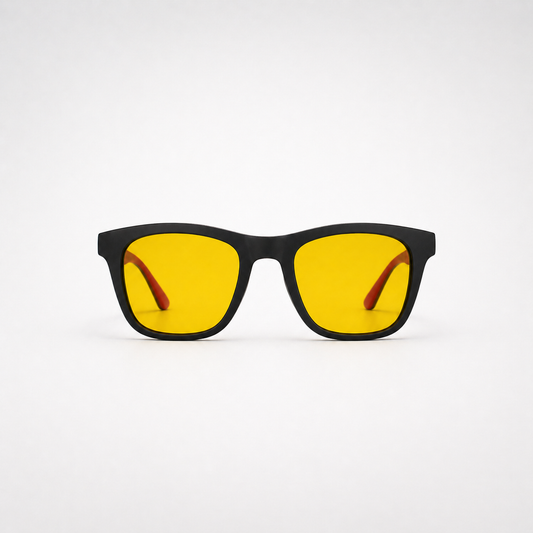
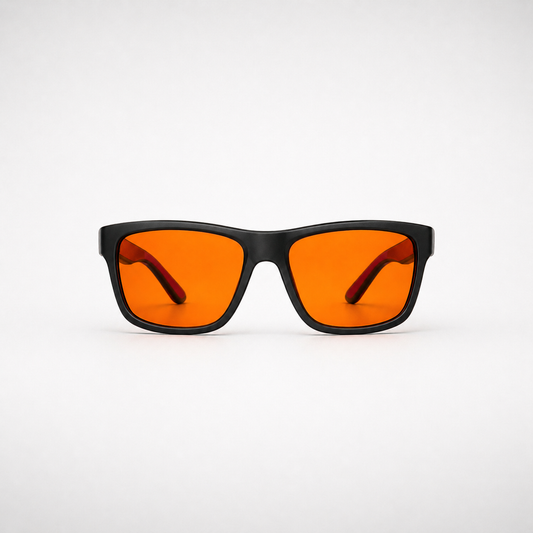
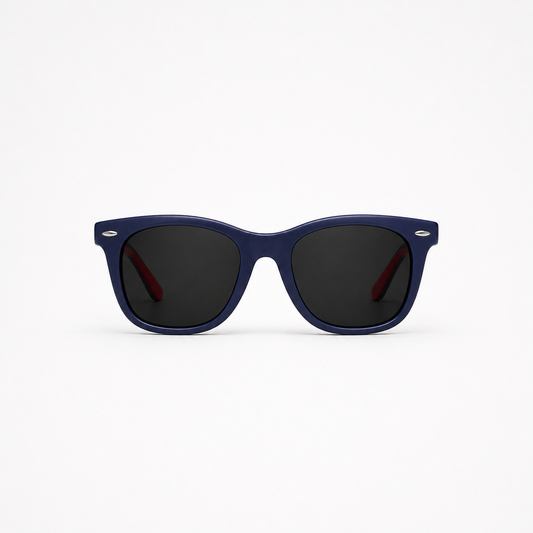
We give you the freedom to keep your favorite frames. Simply send them to us, and we’ll upgrade them with precision-crafted lenses tailored to your exact needs.
After7 · Light & Health
What light does to
your body after dark
The science behind why the wrong kind of light at night disrupts sleep, hormones, and long-term health — and what you can do about it.
Scroll to explore
01 · The Visible Spectrum
Not all light is equal
Sunlight contains every wavelength of visible light. But it's the short-wave, high-energy blue end of the spectrum — roughly 380–500 nm — that your body is most sensitive to, especially at night.
380nm UV
450nm Blue
550nm Green
620nm Red
700nm IR
Your smartphone, LED TV, laptop, and most indoor lighting emit large amounts of blue light — far more than the orange-red candlelight your ancestors evolved with after sunset. Your circadian system hasn't had time to adapt.
The ipRGC cells in your retina (intrinsically photosensitive Retinal Ganglion Cells) are specifically tuned to detect blue light and signal your brain: it's still daytime, stay alert, suppress melatonin.
02 · Your Internal Clock
The circadian rhythm is not a metaphor
It's a molecular clock running inside virtually every cell of your body, synchronized primarily by light. When that clock desynchronises, things go wrong — from the cellular level upward.
During the Day
Blue-rich light is natural and beneficial. It boosts alertness, mood, and cognitive performance. It suppresses melatonin appropriately — keeping you awake when you should be awake.
Getting adequate bright daylight (ideally outdoors) anchors your clock firmly and makes your night-time melatonin rise stronger and earlier.
After Sunset
The same blue light becomes harmful. Your body expects darkness or warm firelight. Instead, screens and LEDs flood your retinas with the signal that keeps your clock stuck at noon.
Melatonin onset is delayed by 1.5–3 hours when you use screens before bed — even at typical indoor brightness levels.
23%
Melatonin suppressed after just 1 hour of evening screen use
38%
Melatonin suppressed after 2 hours — nearly half your natural production
2 hrs
Minimum screen-free time before bed recommended to restore melatonin onset
Source: Monteith et al. The potential influence of LED lighting on mental illness. ResearchGate, 2018.
02b · The Master Clock
Your body runs on coordinated clocks
The word circadian comes from the Latin circa dies — approximately one day. Every organ system runs its own peripheral clock, all synchronised to a central "Master Clock" in the suprachiasmatic nucleus (SCN) of the hypothalamus. Light entering the eyes — even through closed eyelids — is the primary synchronising signal.
Think of the SCN as the US Naval Observatory master clock: every subordinate clock in your body checks in with it, waiting for the signal to fire. When the master clock runs on time, every downstream system — digestion, immunity, hormone release, cell division — runs on time too.
When you flood your retinas with blue light at 11 PM, you send a noon-time signal to your master clock. Every peripheral clock adjusts accordingly. The liver thinks it's lunchtime. Your immune system re-schedules its overnight repair work. Your cardiovascular system doesn't get its nightly recovery window.
Misalignment isn't just tiredness. It's every system in your body operating out of sync.
Heart
Liver
Immune
Gut
Adrenal
Skin
Kidney
Lung
MASTER
CLOCK
SCN
CLOCK
SCN
03 · A Night with Blue Light
What happens when you scroll until midnight
8:00 PM
Melatonin should begin rising
Normally your brain starts secreting melatonin about 2 hours before natural sleep time. Blue light from screens blocks this process via the suprachiasmatic nucleus (SCN) in the hypothalamus.
10:00 PM
Core body temperature should start falling
Sleep onset requires a drop in core body temperature. Circadian disruption delays this, making it harder to feel sleepy even when you're physically tired.
11:30 PM
You finally put the phone down
Melatonin starts rising now — nearly 2 hours late. Your total melatonin exposure overnight will be compressed and reduced.
12:30 AM
Sleep begins, but it's shallower
Less slow-wave deep sleep, less REM sleep. Cognitive restoration, immune function, and emotional processing are all compromised. Growth hormone secretion — which peaks in early deep sleep — is reduced.
6:30 AM
Alarm goes off — you're underslept
Melatonin is still circulating due to the delayed schedule. You wake into a foggy, dysregulated state. Cortisol awakening response is blunted. The cycle repeats.
04 · Health Consequences
The long-term cost of light pollution
Research — including studies published in Nature, The Lancet, and journals of the American Academy of Sleep Medicine — links chronic circadian disruption to a range of serious health outcomes.
01
Metabolic Disruption
Night-shift workers and people with consistently disrupted sleep show higher rates of obesity, type 2 diabetes, and metabolic syndrome. Insulin sensitivity drops markedly after just a few nights of poor sleep.
02
Cardiovascular Risk
Chronic circadian misalignment is associated with elevated blood pressure, inflammation markers, and increased risk of cardiovascular events. The heart follows a circadian rhythm — disrupt the clock, disrupt the heart.
03
Immune Suppression
The immune system is profoundly circadian. Cytokine production, T-cell activity, and vaccine response all peak at specific times. Poor sleep consistently reduces immune resilience.
04
Mental Health
Circadian disruption is strongly correlated with depression, anxiety, bipolar disorder, schizophrenia, seasonal affective disorder, and ADHD. LED lighting is of particular concern to psychiatry — it emits far more blue light than incandescent bulbs, and many mental illnesses are directly associated with circadian rhythm dysregulation.
05
Cancer Risk
The WHO classifies night-shift work as a probable carcinogen. Melatonin functions as a powerful antitumour agent — it exerts antioxidant effects and inhibits cancer cell growth. Suppressing it nightly via artificial light removes a key layer of biological protection. Epidemiological studies link light-at-night exposure with higher incidence of breast, prostate, and colorectal cancers.
06
Cognitive Decline
Deep sleep is when your brain's glymphatic system clears amyloid-beta — the protein implicated in Alzheimer's. Chronic sleep shortfall is one of the most modifiable risk factors for dementia.
04b · Artificial Light at Night
ALAN — the hidden disruptor in every room
Artificial Light at Night (ALAN) doesn't just affect shift workers. It's in your living room, your bedroom, your phone on the nightstand. And unlike natural light, it comes with no sunset — no gradual dimming, no shift to warm wavelengths, no signal to your brain that the day is over.
How ALAN tricks your brain
Your brain evolved to read light colour as a time-of-day signal. Warm red-orange light (like fire or sunset) means evening. Blue-white light means high noon. Modern LED screens and lighting emit predominantly blue-white light — so even a bedside lamp or a 10-minute phone check sends your master clock a "stay awake" signal that can take hours to reverse.
The dose-response relationship
The harmful effects of ALAN are not binary — they scale with both brightness and duration. A dim screen for 30 minutes causes less disruption than a bright TV for 3 hours. But research confirms there is no safe threshold — even low-level ALAN measurably shifts melatonin timing, increases sleep latency, and raises core body temperature at sleep onset.
Studies published in the CDC's NIOSH research programme show that light — specifically its colour — has a powerful dose-response effect on circadian rhythms. The warmer the light, the less the disruption. The solution isn't to go to bed at sunset — it's to manage the wavelengths reaching your eyes in the evening hours.
04c · The Melatonin–Cancer Connection
Melatonin is more than a sleep hormone
Most people know melatonin helps you fall asleep. Far fewer know it is a potent antioxidant and one of the body's primary cancer-defence molecules — and that blue light at night shuts down its production precisely when it's most needed.
The Disruption Pathway
Blue light → ipRGC cells fire → SCN signals pineal gland → melatonin secretion suppressed → circadian system misaligned → cell cycle clock disrupted → abnormal cell growth risk increases.
Cancer is fundamentally a disease of uncontrolled cell division. The circadian clock and the cell cycle are tightly coupled at a molecular level. When the circadian clock is chronically disrupted, so is the regulation of cell division.
The Melatonin Shield
When melatonin is secreted naturally — in darkness, on a consistent schedule — it acts as a direct antitumour agent: scavenging free radicals, inhibiting cancer cell proliferation, promoting apoptosis (programmed cell death), and even enhancing the effectiveness of certain chemotherapy agents.
Researchers describe melatonin as a "powerful antitumour agent." It only works when you let it be produced — which means keeping nights dark.
04d · Cognitive Function & Mental Health
Edison's lightbulb changed everything — not all of it good
For billions of years, human cognition evolved within a strict light-dark cycle. In less than 150 years, artificial light has upended that. Researchers are now mapping the neurological consequences.
MELATONIN & THE BRAIN
Melatonin doesn't just regulate sleep — it improves cognitive performance and may slow biological ageing of the brain. In Alzheimer's and Parkinson's disease, melatonin shows preventive effects on neurodegeneration. The glymphatic system — which clears amyloid-beta and other metabolic waste from the brain — operates almost exclusively during deep sleep. Reduce deep sleep and metabolic waste accumulates.
LED & PSYCHIATRY
LED lighting emits substantially more blue light than incandescent bulbs and is now the global default. The psychiatric research community is increasingly alarmed — LED exposure has been linked to worsening of bipolar disorder, depression, schizophrenia, seasonal affective disorder, and ADHD. Good circadian health requires both synchronisation with the external environment and internal system-wide alignment.
07 · Light Sources
Not all artificial light is equally harmful
The biological impact depends on colour temperature (CCT), peak wavelength, and intensity. Here's how common light sources compare for evening use.
Light Source
Blue Light (470nm) Emission
Evening Suitability
Smartphone / Tablet screen
Very High
Poor — use with filter
LED TV (6500K "daylight")
High
Poor
LED overhead lighting (4000K)
Moderate–High
Fair — dim it down
Warm LED bulb (2700K)
Low–Moderate
Better
Incandescent / halogen
Low
Good
Salt lamp / firelight
Negligible
Excellent
After7 blue-blocking glasses
Filtered at source
Excellent — use with any screen
08 · The Master Clock
Your body runs on one master signal
The circadian system isn't a single clock — it's a network. Every organ, every cell has its own peripheral clock. They all take their timing cue from one master pacemaker: the suprachiasmatic nucleus (SCN) in the hypothalamus. And the SCN takes its cue from one thing above all else: light.
🧠
SCN Master Clock
Receives light signals from ipRGC retinal cells. Broadcasts timing to every organ system via hormones and neural pathways.
⚙️
Peripheral Clocks
Heart, liver, gut, skin, immune cells — all have local circadian clocks controlling gene expression on a 24-hour schedule.
🔗
Synchronisation
When the master clock is disrupted by wrong-wavelength light at night, peripheral clocks fall out of sync — like an orchestra playing from different sheets.
This is why consequences of light pollution aren't limited to poor sleep. Every body system that runs on a clock — metabolism, immunity, cell division, mood regulation — is affected when the master signal is corrupted.
09 · The Melatonin Numbers
Two hours of screens.
38% less melatonin.
Melatonin is the chemical signal of darkness. Its release is triggered by the transition from light to dark — but only if that transition actually happens. Research quantifies exactly how badly screens interfere.
MELATONIN PRODUCTION REMAINING
No screens (baseline)
100%
1 hour of screen use
77%
2 hours of screen use
62%
Source: Monteith et al. (2017). The potential influence of LED lighting on mental illness.
The supplement trap: Melatonin pills can't replicate the natural blood-level curve your body produces. Timing, dosage, and the gradual rise-and-fall profile are nearly impossible to mimic with a supplement. Blocking blue light lets your body do it naturally — every night, automatically.
10 · Mind & Mood
The light–mental health connection
For billions of years, the sun was the only clock life on Earth had. The light bulb arrived 150 years ago. LED screens, 20 years ago. Your brain hasn't adapted — and the psychiatric consequences are now well-documented.
🌀
Bipolar Disorder
Circadian disruption is one of the most consistent biological findings in bipolar disorder. Irregular sleep-wake cycles can both trigger and worsen manic and depressive episodes.
🌫️
Depression & SAD
Seasonal Affective Disorder is a direct consequence of light timing. Year-round disruption from artificial light at night mimics the shortened winter days that trigger persistent low-mood states.
⚡
ADHD
Emerging research links circadian dysregulation to ADHD symptoms. Melatonin onset is consistently delayed in people with ADHD — a cause-and-consequence cycle that compounds over time.
🧩
Schizophrenia & Alcoholism
Both conditions show disrupted circadian clock gene expression. The clock regulates dopamine, serotonin, and cortisol rhythms that underpin mood and reward processing.
🧬
Alzheimer's & Parkinson's
Melatonin has demonstrated preventative effects in both AD and PD neurodegeneration models. It also facilitates the glymphatic clearance of amyloid-beta during deep sleep.
🔋
Cognitive Performance
Study data shows melatonin directly improves cognitive performance and slows age-related mental decline. Consistent nighttime melatonin release is one of the most accessible cognitive-longevity tools there is.
11 · Cancer & The Cell Cycle
Melatonin as your body's
cancer defence
The evidence linking light-at-night to cancer risk is robust enough that the WHO classifies night-shift work — and its associated chronic light exposure — as a probable human carcinogen.
How it works at the molecular level
The circadian clock and the cell cycle are tightly linked. Clock genes directly regulate proteins that control when cells divide. When the clock is disrupted, this regulation breaks down — and abnormal, uncontrolled cell growth becomes more likely.
Melatonin acts as a direct antitumor agent through multiple pathways: antioxidant activity, immune stimulation, and direct inhibition of tumour cell growth. Suppressing it nightly systematically removes this layer of protection.
MELATONIN'S ANTI-CANCER ROLES
✓
Potent antioxidant — neutralises free radicals that damage DNA
✓
Regulates cell cycle checkpoint proteins (p53, Bcl-2)
✓
Inhibits tumour angiogenesis (blood vessel growth feeding tumours)
✓
Stimulates NK (Natural Killer) immune cell activity against cancer cells
✓
Epidemiological links to reduced breast, prostate, and colorectal cancer rates in good-light-hygiene populations
The bottom line: Every night you expose yourself to unblocked blue light, you reduce the very hormone responsible for protecting your cells from abnormal growth. This isn't a fringe theory — it's the consensus of multiple epidemiological and molecular studies published in peer-reviewed journals.
12 · What You Can Do
The after 7 protocol
You don't have to give up screens. You just need to manage the light they emit. Here's the hierarchy of interventions, from least to most effective:
Software
Screen warm mode / Night Shift / f.lux
Useful but limited. These tools shift colour temperature but rarely go far enough — most still emit meaningful blue light. They also don't help with ambient room lighting.
Lighting
Switch to warm bulbs after sunset
Replace overhead LEDs with 2200–2700K bulbs in your main living areas. This significantly reduces your ambient blue light load and is a permanent, set-and-forget improvement.
Best
After7 blue-blocking glasses
The most reliable solution. Purpose-made lenses that filter the critical 380–500nm range protect you regardless of screen settings, room lighting, or environment. Put them on after 7 PM and your circadian system gets the signal it needs.
After7 · Sleep Better, Think Clearer
Your nights are worth
protecting
Science-backed blue-blocking glasses designed for the modern world. Worn after 7 PM. Felt every morning.
Shop After7 GlassesWhy Choose Us
Our Unique Things
At After7, we combine style, precision, and comfort to deliver eyewear that truly enhances your everyday life. Our expert-crafted lenses are tailored to your unique vision needs, including prescription and blue light protection options, ensuring clarity and long-lasting comfort. With our Custom Lens Fit service, you can even upgrade your favorite frames without compromising your personal style.
“ After7, is driven by a passion for combining style with functionality in modern eyewear. With a clear vision to make premium-quality lenses and fashionable frames accessible to everyone, he established After7 to deliver precision, comfort, and confidence through every product. His leadership continues to inspire innovation and customer-focused excellence within the brand.”
Mr Mahesh, CEO & Founder After7
How We Work
More to Explore
Discover a world of style, clarity, and innovation with After7. From precision-crafted prescription lenses to advanced blue light protection and modern frame collections, there’s always something designed to match your lifestyle.